Call Us
+86 136 6007 9809
Call Us
+86 136 6007 9809

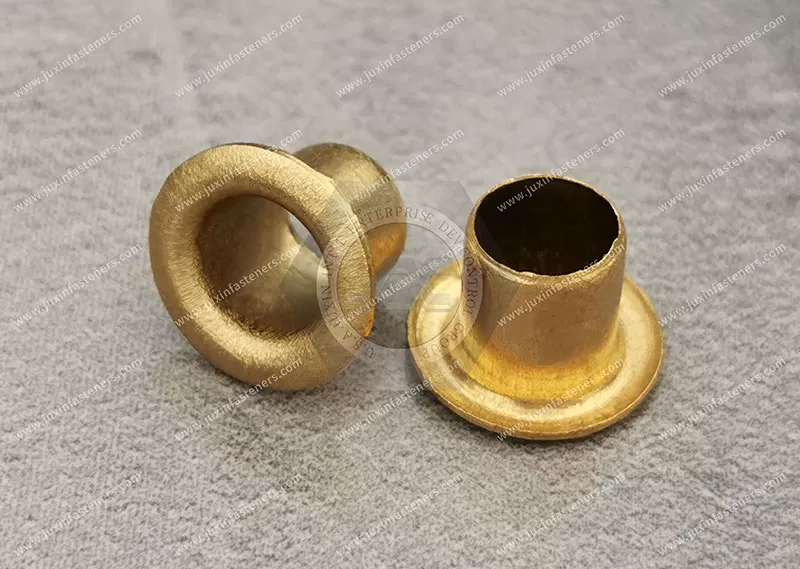
JUXIN FASTENERS supplies brass tubular eyelets for OEM applications requiring hole reinforcement, tubular-end fastening, or a protected opening through thin materials.
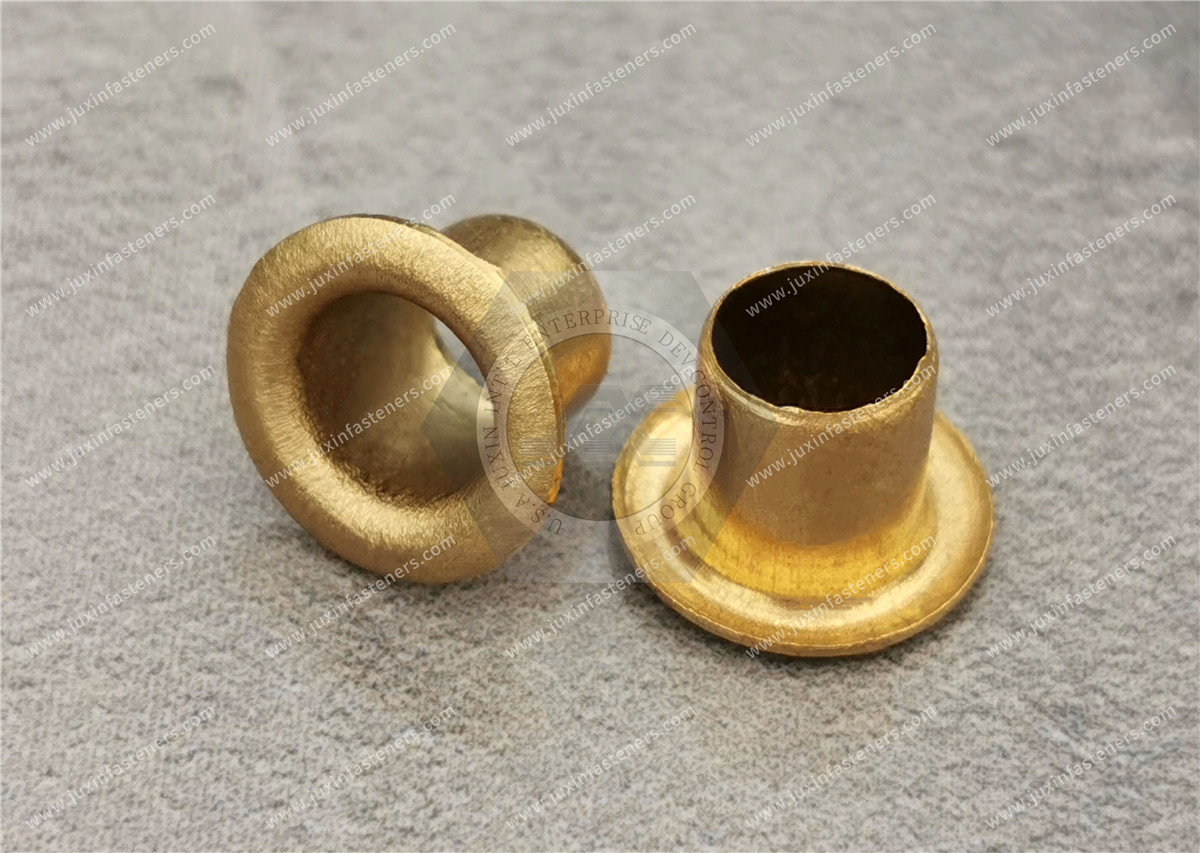
These hollow brass components feature a formed flange and tubular barrel that can be rolled or flared during installation.
Applications may include electronics, electrical equipment, appliance hardware, metal and plastic components, leather, and textiles. Barrel dimensions,
flange geometry, material grade, and size codes require drawing confirmation.
Product Specification
Brass Tubular Eyelets
Custom Brass Eyelet Rivets for OEM Electronics, Electrical Equipment, Sheet Metal, Plastic Components and Industrial Assembly
JUXIN FASTENERS supplies brass tubular eyelets for industrial OEM manufacturers requiring small hollow metal fasteners, reinforced openings, and controlled tubular-barrel forming.
Also known as brass eyelet rivets, brass metal eyelets, brass flange eyelets, and brass hollow-body rivets in certain applications, these components feature an open tubular barrel and an integral flange at one end.
During installation, the opposite end of the barrel is rolled, curled, or flared to retain the eyelet in the assembled material.
Depending on the design, a brass eyelet may reinforce a hole, protect a passing component from sharp edges, retain thin materials, or provide a mechanical connection.
JUXIN welcomes drawing-based inquiries from electronics manufacturers, electrical equipment producers, appliance manufacturers, automotive component suppliers, industrial assembly companies, and OEM procurement teams.
Product Specifications and Construction
Product Name: Brass Tubular Eyelets
Alternative Name: Brass Tubular Eyelet Rivets
Product Category: Hollow Rivets / Metal Eyelets
Material: Brass
Brass Alloy: According to Approved Customer Specification
Construction: Hollow Tubular Barrel
Head Style: Integral Flange
Flange Profile: According to Approved Drawing
Barrel Outside Diameter: According to Approved Drawing
Barrel Inside Diameter: According to Approved Drawing
Barrel Length: According to Approved Drawing
Flange Outside Diameter: According to Approved Drawing
Flange Thickness: According to Approved Drawing
Wall Thickness: According to Approved Drawing
Material Temper: According to Approved Specification
Surface Finish: According to Customer Requirements
Installation Method: Tubular-End Rolling, Curling or Flaring
Installation Access: According to Approved Assembly Process
Custom Production: Subject to Engineering Review
Packaging: According to Customer Requirements
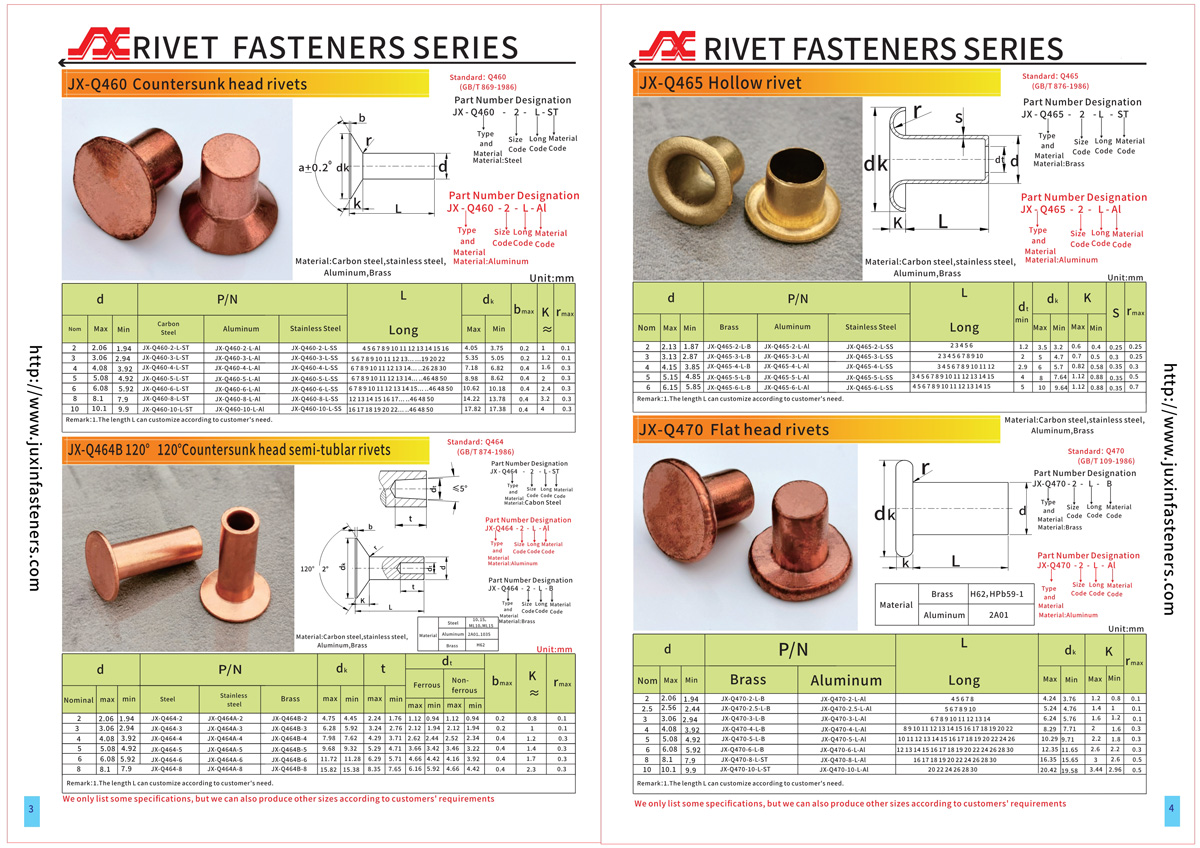
Original Catalog Size References
The existing product information lists the following nominal size codes:
M0.9, M1.3, M1.5, M1.7, M2, M2.3, M2.5, M3, M4, M5 and M6.
These codes require verification against the original dimensional table.
They must not be interpreted automatically as barrel inside diameters, outside diameters, installation hole diameters, or metric thread sizes.
Brass tubular eyelets are unthreaded components.
The approved drawing must establish the actual dimensions and available specifications.
What Are Brass Tubular Eyelets?
Brass tubular eyelets are small hollow metal components consisting of a tubular barrel and a flange formed at one end.
The barrel passes through a prepared opening in the workpiece.
During installation, the opposite end of the barrel is mechanically deformed to form a retaining lip or flange.
This operation secures the eyelet within the material.
Depending on the application, the installed eyelet may:
Reinforce a punched or drilled hole
Protect a passing wire or cord
Reduce wear at the hole edge
Retain thin layers of material
Provide a formed metal opening
Support a mechanical fastening function
Provide a decorative metal finish
The exact function depends on the eyelet geometry, material thickness, installation process, and assembly design.
American and European Product Terminology
Brass Tubular Eyelets
The recommended primary product name for hollow brass eyelets with a tubular barrel.
Brass Eyelets
A widely used industrial and commercial term for small metal hole-reinforcement components.
Brass Tubular Eyelet Rivets
A useful procurement term where the eyelet also performs a fastening or retaining function.
Brass Metal Eyelets
A broader material-specific search term.
Brass Flange Eyelets
Describes eyelets with an integral flange.
Brass Flat Flange Eyelets
Used where the flange has a flat configuration.
Brass Rolled-Rim Eyelets
Used for particular rim geometries; this name should only be applied when the drawing confirms a rolled rim.
Brass PCB Eyelets
An application-specific term for eyelets designed for printed circuit board assemblies.
Brass Hollow-Body Rivets
A related fastening term that may describe suitable tubular rivet constructions.
Brass Grommets
A related hole-reinforcement category, but not necessarily identical to a tubular eyelet.
Eyelets Versus Grommets
Eyelets and grommets may perform similar hole-reinforcement functions, but their dimensions and construction can differ.
Eyelets
Typically feature a relatively small flange and a tubular barrel.
They are often used in electronics, garments, leather goods, labels, thin materials, and precision assemblies.
Grommets
Often feature a larger flange relative to the opening and may be used with a separate washer.
They are commonly selected for applications requiring greater bearing area or reinforced openings.
Engineering Selection
The correct component depends on:
Opening diameter
Flange diameter
Material thickness
Pull-out requirements
Installation method
Appearance
Environmental exposure
An eyelet should not be substituted for a grommet without checking the assembly requirements.
Eyelets Versus Semi-Tubular Rivets
The internal construction is an important difference.
Tubular Eyelets
Feature a hollow barrel that provides an opening through the component.
Semi-Tubular Rivets
Feature a partially hollow tail and a substantial solid shank section.
Solid Rivets
Feature a solid shank that is upset during installation.
Engineering Implications
These different constructions affect:
Remaining material cross-section
Forming force
Installed geometry
Mechanical retention
Joint loading
Available passage through the fastener
A fully hollow eyelet should not be described as a semi-tubular rivet.
Brass Eyelet Geometry and Dimensional Requirements
Accurate dimensions are essential for reliable installation.
Barrel Outside Diameter — OD
The outside diameter determines the fit within the prepared hole.
Barrel Inside Diameter — ID
The inside diameter determines the available opening through the eyelet.
Barrel Length
The barrel must accommodate the material thickness and provide enough material for forming the retaining flange.
Flange Diameter
The flange provides a bearing surface against the workpiece.
Flange Thickness
Affects the external profile and contact geometry.
Wall Thickness
Influences forming behavior and mechanical retention.
Flange Profile
May be flat, rolled, curved, or otherwise defined by the approved drawing.
Barrel Roundness
May influence insertion, tooling alignment, and installation quality.
Dimensional Tolerances
Must be specified according to the assembly requirements.
For miniature eyelets, small dimensional differences can significantly affect installation performance.
Metric and Inch Eyelet Dimensions
American electronic hardware catalogs frequently use inch dimensions for eyelets.
European and international engineering drawings may use metric dimensions.
Common dimensional descriptions include:
Barrel OD
Barrel ID
Flange OD
Length under flange
Overall length
Material thickness
Installation hole diameter
For reference:
1 mm = approximately 0.03937 inch.
1/16 inch = approximately 1.5875 mm.
1/8 inch = approximately 3.175 mm.
These conversions are dimensional references only.
They do not establish interchangeable product sizes or confirm JUXIN's available specifications.
The approved drawing determines the actual eyelet dimensions.
Brass Material Properties
Brass is a copper-based alloy family containing zinc.
Its properties depend on the selected alloy and material condition.
Formability
Suitable brass grades can be formed into thin-wall tubular components.
Corrosion Resistance
Brass provides useful corrosion resistance in many environments, although performance varies with alloy and exposure.
Electrical Conductivity
Brass conducts electricity, but generally has lower conductivity than high-conductivity copper grades.
Thermal Conductivity
Brass provides thermal conductivity that varies with alloy composition.
Appearance
Brass offers a distinctive yellow metallic appearance.
Mechanical Properties
Strength, hardness, and ductility depend on the alloy and temper.
Surface Finishing
Suitable brass components may be compatible with specified plating or finishing processes.
The exact brass alloy must be selected according to the customer's application.
Brass Alloy and Temper Selection
Brass eyelet manufacturing requires material with appropriate forming properties.
Important selection factors include:
Alloy composition
Material temper
Ductility
Tensile strength
Hardness
Forming behavior
Corrosion environment
Electrical requirements
Surface finish
Manufacturing cost
The material must permit controlled tubular-barrel deformation without unacceptable cracking.
No particular brass grade should be assigned to this product without an approved material specification.
How Brass Tubular Eyelets Are Manufactured
Manufacturing methods depend on the geometry, material thickness, and production volume.
Metal Stamping
Thin brass strip may be processed into suitable eyelet blanks.
Deep Drawing
Forming operations may create the tubular barrel and integral flange.
Piercing
A central opening may be produced during the manufacturing process.
Flange Forming
The required flange profile is formed according to the tooling design.
Sizing
The barrel and flange dimensions are controlled according to the approved drawing.
Surface Finishing
Cleaning or other specified finishing operations may be applied.
Inspection
Critical dimensions and material requirements are checked.
The actual manufacturing process for each JUXIN eyelet design is determined by engineering review and production feasibility.
How Brass Eyelets Are Installed
Eyelets are generally installed by deforming the open end of the tubular barrel.
Prepare the Material
Create a suitable hole in the workpiece.
Select the Eyelet
Confirm barrel diameter, length, flange dimensions, and material specification.
Insert the Barrel
Position the eyelet through the prepared hole.
Support the Factory Flange
Use a suitable anvil or support fixture.
Align the Setting Tool
Position the forming tool against the open barrel end.
Form the Retaining Lip
Apply controlled pressure to roll or flare the tubular end.
Inspect the Installation
Check flange formation, material condition, and mechanical retention.
The correct setting process depends on the eyelet geometry and workpiece material.
Eyelet Setting Equipment
Different equipment may be appropriate for different applications.
Manual Eyelet Setting Tools
May be used for selected low-volume applications.
Hand Presses
Can provide controlled forming for suitable parts.
Pneumatic Presses
May be considered for repetitive production.
Mechanical Eyelet Setting Machines
Can support industrial installation processes.
Automated Feeding and Setting Systems
May be evaluated for higher production volumes.
Dedicated Tooling
Can improve positioning and forming consistency.
Tooling must match the barrel diameter, flange profile, material thickness, and required installed geometry.
Barrel Length and Material Thickness
Correct barrel length is important for successful installation.
The barrel must extend through the material and provide enough projection to form the retaining lip.
Insufficient Barrel Projection
May prevent complete flange formation.
Excessive Barrel Projection
May cause irregular rolling or buckling.
Incorrect Workpiece Thickness
May result in loose retention or excessive compression.
Material Compressibility
Soft materials may deform under setting pressure.
Tool Geometry
The forming punch must produce the required rolled or flared profile.
The correct length should be determined from the approved assembly drawing and validated setting process.
Application: Printed Circuit Board Eyelets
Brass eyelets are used in certain electronic hardware applications.
Potential functions include:
Reinforcing holes
Supporting component lead connections
Providing mechanical retention
Supporting conductive connections where designed
Repairing selected plated-through-hole structures
Important engineering considerations include:
PCB thickness
Barrel outside diameter
Barrel inside diameter
Hole clearance
Flange diameter
Pad clearance
Electrical requirements
Plating compatibility
Installation force
A general brass eyelet is not automatically suitable for PCB repair or conductive interconnection.
The exact product must be designed and qualified for the intended electronic application.
Application: Electronic Components
Small brass eyelets may be considered for selected electronic assemblies.
Potential applications include:
Electronic hardware
Mechanical connection points
Instrument components
Miniature retaining fittings
Customer-specific assemblies
The required dimensions and electrical properties must be verified.
Application: Electrical Equipment
Brass eyelets may be evaluated for selected electrical equipment components.
Potential applications include:
Terminal hardware
Equipment fittings
Small mechanical retainers
Protected openings
Electrical assembly hardware
Where the eyelet is part of a conductive path, electrical resistance and temperature rise must be evaluated.
Application: Household Appliances
Appliance manufacturers may use eyelets in suitable mechanical or electrical assemblies.
Potential applications include:
Small hardware fittings
Metal panel openings
Electrical component supports
Mechanical retainers
Customer-specific appliance components
The component must meet the applicable electrical safety, temperature, and mechanical requirements.
Application: Automotive Components
Brass tubular eyelets may be considered for suitable automotive component assemblies.
Potential applications include:
Electrical component hardware
Interior fittings
Small mechanical assemblies
Protected openings
Customer-specific retaining components
Automotive applications may require vibration, temperature, corrosion, and production quality validation.
No safety-critical automotive suitability is implied without supporting qualification.
Application: Thin Sheet Metal Assemblies
Tubular eyelets may be used in selected thin-metal applications.
Potential functions include:
Reinforcing a prepared hole
Protecting an opening edge
Retaining lightweight components
Creating a formed metal passage
Engineering considerations include:
Sheet thickness
Hole diameter
Edge distance
Flange bearing area
Installation force
Local deformation
The eyelet must be suitable for the workpiece material and required loads.
Application: Plastic Components
Brass eyelets may be evaluated for selected plastic assemblies.
Potential applications include:
Reinforced mounting openings
Small mechanical fittings
Protective passages
Lightweight retaining components
Plastic components require attention to creep, compression, cracking, and thermal expansion.
Installation force must be controlled to avoid damaging the workpiece.
Application: Composite Materials
Tubular eyelets may be used in suitable composite components.
Important considerations include:
Hole quality
Local bearing pressure
Delamination risk
Material thickness
Flange geometry
Installation force
Long-term retention
The assembly must be validated for the specific composite material.
Application: Leather Goods
Brass eyelets are commonly used in suitable leather applications.
Potential functions include:
Reinforcing lace holes
Protecting hole edges
Providing decorative metal openings
Retaining selected layered materials
The eyelet dimensions must match the leather thickness and installation requirements.
Application: Footwear
Brass eyelets may be used in footwear manufacturing.
Potential applications include:
Lace openings
Reinforced fabric holes
Decorative hardware
Leather fastening components
The required corrosion resistance, appearance, and pull-out performance depend on the product design.
Application: Textiles and Fabric Assemblies
Tubular eyelets may be suitable for certain textile products.
Potential applications include:
Reinforced openings
Cord passages
Fabric attachments
Decorative components
For thin or soft materials, washers or reinforcement layers may be required depending on the design.
Application: Stationery and Office Products
Brass eyelets may be used in selected stationery and office equipment applications.
Potential uses include:
Document binding
Tags and labels
Paperboard assemblies
Decorative metal openings
Small retaining components
The required dimensions and forming process depend on material thickness and production volume.
Application: Industrial Tags and Labels
Metal eyelets may reinforce holes in industrial identification products.
Potential applications include:
Equipment identification tags
Metal or plastic labels
Hanging tags
Industrial marking components
The eyelet must provide suitable retention without damaging the tag material.
Application: Lighting Equipment
Brass tubular eyelets may be considered for selected lighting hardware.
Potential applications include:
Small mechanical fittings
Electrical component hardware
Metal enclosure openings
Decorative components
Electrical insulation, grounding, and temperature requirements must be evaluated separately.
Application: Cable and Wire Pass-Through Protection
An eyelet may provide a formed edge around a hole.
However, brass eyelets do not automatically provide the same abrasion protection, insulation, sealing, or strain relief as purpose-designed cable grommets.
Where wires pass through metal panels, the complete assembly must be evaluated for:
Edge smoothness
Electrical insulation
Cable movement
Vibration
Abrasion
Temperature
Environmental exposure
A separate insulating bushing or protective component may be required.
Electrical Conductivity and Contact Performance
Brass conducts electricity, but the electrical behavior of an installed eyelet depends on the complete assembly.
Important factors include:
Brass alloy
Surface finish
Contact pressure
Oxidation
Mating material
Temperature
Vibration
Contact geometry
Electrical performance must be verified where the eyelet is intended to provide a conductive connection.
Mechanical Retention and Pull-Out Resistance
The retention strength of a tubular eyelet depends on its geometry and installation.
Important factors include:
Flange diameter
Barrel diameter
Wall thickness
Material thickness
Formed lip dimensions
Brass material condition
Installation force
Workpiece strength
Washer or reinforcement design
Tubular eyelets should not be assumed to provide the same shear or tensile strength as solid rivets.
The complete assembly must be evaluated according to the intended loads.
Corrosion Resistance and Surface Finishing
Brass provides useful corrosion resistance in suitable environments.
However, corrosion performance depends on:
Alloy composition
Moisture exposure
Chemicals
Surface finish
Contact with dissimilar metals
Temperature
Mechanical stress
Possible surface finishes may include natural brass, nickel plating, or tin plating where technically appropriate and available.
No particular finish should be treated as available for this product without confirmation.
Production Engineering and Automated Eyelet Setting
For production managers, brass tubular eyelets may provide an efficient method of retaining small components or reinforcing holes.
Important process controls include:
Brass material identification
Barrel outside diameter
Barrel inside diameter
Barrel length
Flange diameter
Wall thickness
Workpiece hole diameter
Material stack-up
Setting pressure
Forming punch geometry
Installed lip dimensions
Visual inspection
Production traceability
For suitable production volumes, automated eyelet feeding and setting equipment may be evaluated.
Actual process capability must be established through validation.
Common Eyelet Installation Problems
Incomplete Barrel Flare
May result from insufficient setting force or incorrect tooling.
Cracked Barrel
May indicate unsuitable material condition or excessive deformation.
Uneven Rolled Lip
May result from tool misalignment.
Loose Eyelet
May indicate incorrect barrel length, hole diameter, or installation force.
Flange Deformation
May result from inadequate support.
Workpiece Tearing
May occur when the flange provides insufficient bearing area.
Plastic Cracking
May result from excessive installation pressure.
Surface Damage
May result from incompatible tooling or handling.
Corrective action should follow the approved engineering and process requirements.
Quality Control for Brass Tubular Eyelets
Relevant inspection characteristics may include:
Brass alloy
Material temper
Barrel outside diameter
Barrel inside diameter
Barrel length
Flange diameter
Flange thickness
Wall thickness
Roundness
Surface condition
Dimensional tolerances
Formed lip geometry
Pull-out resistance where specified
Electrical performance where required
Packaging and traceability
Inspection methods and acceptance criteria should be established according to the approved customer drawing.
Engineering Standards and Custom Drawing Requirements
Industrial eyelets may be specified according to manufacturer drawings, customer specifications, or applicable product standards.
Because eyelet construction varies by application, a standard should not be assigned solely from the product name.
For custom OEM production, the approved engineering drawing should define:
Material
Dimensions
Tolerances
Flange geometry
Barrel geometry
Surface finish
Installation requirements
Inspection criteria
No claim of compliance with a particular DIN, ISO, ASME, ASTM, SAE, or other standard should be made without verification.
Custom Brass Eyelet Manufacturing
JUXIN FASTENERS welcomes drawing-based inquiries for custom brass tubular eyelets.
Potential custom requirements include:
Miniature barrel diameters
Special inside diameters
Custom flange diameters
Different barrel lengths
Controlled wall thickness
Special flange profiles
Customer-specified brass alloys
Surface finish requirements
Dimensional tolerances
Customer-specific packaging
Custom production is subject to engineering review, material availability, and manufacturing feasibility.
OEM Procurement and Supplier Qualification
OEM purchasing teams may require structured supplier evaluation.
Depending on the project, requirements may include:
Approved engineering drawing
Drawing revision control
Material specification
Dimensional inspection report
First article inspection
Production process documentation
Material traceability
Surface finish verification
Installation validation
Customer-specific quality records
The required documentation should be agreed before production.
OEM RFQ Requirements
For an accurate quotation, please provide:
Customer part number
2D engineering drawing
3D CAD model, if available
Brass alloy
Material temper
Barrel outside diameter
Barrel inside diameter
Barrel length
Flange diameter
Flange thickness
Wall thickness
Dimensional tolerances
Workpiece material
Material thickness
Installation hole diameter
Required setting method
Surface finish
Functional requirements
Packaging and labeling
Order quantity
Estimated annual demand
Quality documentation requirements
Complete technical information supports engineering review and accurate quotation.
Frequently Asked Questions
What are brass tubular eyelets?
They are hollow brass components with an integral flange and tubular barrel. The barrel is rolled or flared during installation to retain the eyelet.
Are brass eyelets the same as brass grommets?
Not necessarily. The categories overlap in some applications, but flange geometry, construction, and intended use may differ.
Are brass tubular eyelets the same as semi-tubular rivets?
No. Tubular eyelets have a hollow passage, while semi-tubular rivets typically have only a partially hollow tail.
Can brass eyelets be used in printed circuit boards?
Yes, specially designed brass eyelets are used in certain PCB applications. The dimensions, surface finish, and electrical requirements must be appropriate.
Can brass eyelets provide electrical conductivity?
Brass conducts electricity, but the complete connection must be evaluated where electrical performance is required.
Can brass eyelets reinforce holes in leather and fabric?
Yes. Suitable eyelet designs can reinforce openings in leather, fabric, and other soft materials.
Can brass eyelets be used in automotive components?
They may be used in suitable automotive assemblies, subject to engineering and application qualification.
What dimensions are important when selecting a brass eyelet?
Barrel outside diameter, inside diameter, length, flange diameter, wall thickness, and material thickness are key parameters.
Are M0.9 to M6 eyelet sizes metric threads?
No. Tubular eyelets are unthreaded. The original catalog size codes must be interpreted using the manufacturer's dimensional drawing.
Can JUXIN manufacture custom brass eyelets?
JUXIN welcomes drawing-based inquiries for custom barrel dimensions, flange profiles, material requirements, and production quantities, subject to engineering review.
Request an OEM Quotation — Brass Tubular Eyelets
JUXIN FASTENERS supports electronics manufacturers, electrical equipment producers, appliance manufacturers, automotive component suppliers, industrial OEMs, design engineers, production managers, purchasing managers, sourcing specialists, and global supply chain teams.
For an accurate quotation, please send the 2D engineering drawing or 3D CAD model, brass alloy, barrel outside diameter, barrel inside diameter, barrel length, flange dimensions, wall thickness, material thickness, surface finish, installation requirements, and estimated annual demand.
Please also specify any electrical, mechanical, inspection, or customer-specific packaging requirements.
Email: info@juxinfasteners.com
Website: www.juxinfasteners.com
JUXIN FASTENERS — Custom Brass Eyelets and OEM Industrial Fastening Solutions
Product Packaging
Packaging Standard
At Juxin Fasteners, we apply standardized export packaging to ensure product protection, traceability, and compliance with international logistics requirements.
1. Standard Export Packaging
Unless otherwise specified, all products will be packed according to our factory standard export packaging, which includes:
Moisture-resistant inner protection
Poly bag or small box packing as required
Reinforced export cartons
Clear labeling with part number, specification, batch number, and quantity
Palletizing for sea or air shipment when necessary
Our standard packaging is designed to ensure safe transportation, efficient warehousing, and long-distance international shipping.
2. Customized Packaging Options
We also provide customized packaging solutions according to customer requirements, including but not limited to:
Private labeling
Customized barcodes
Specific carton dimensions
Retail packaging
Special pallet configuration
Customer-specific marking and identification
So that you know, customized packaging may involve additional costs and extended lead time depending on the complexity of the requirements.
3. Compliance & Quality Assurance
All packaging processes are controlled under our ISO 9001 quality management system to ensure consistency, traceability, and product integrity throughout the supply chain.
Product Pictures
Contact Us
Tel.:
+86 020 8621 0320
+86 020 3121 6067
E-mail:
Technical Support:
Navigation
SEND INQUIREY